
#1 Container Mistake Beginners Make in Silk Flower Arrangements
Have you ever stared at a silk flower arrangement you were building and thought something was wrong with your flowers? You bought beautiful stems, you prepped your foam, you followed all the steps and somehow the whole thing still looks sparse and sad. Y’all, I have been there, and I am here to tell you: it is almost never the flowers. The real culprit is one of the most overlooked details in silk flower arranging, and once you know it, you will never make this mistake again.
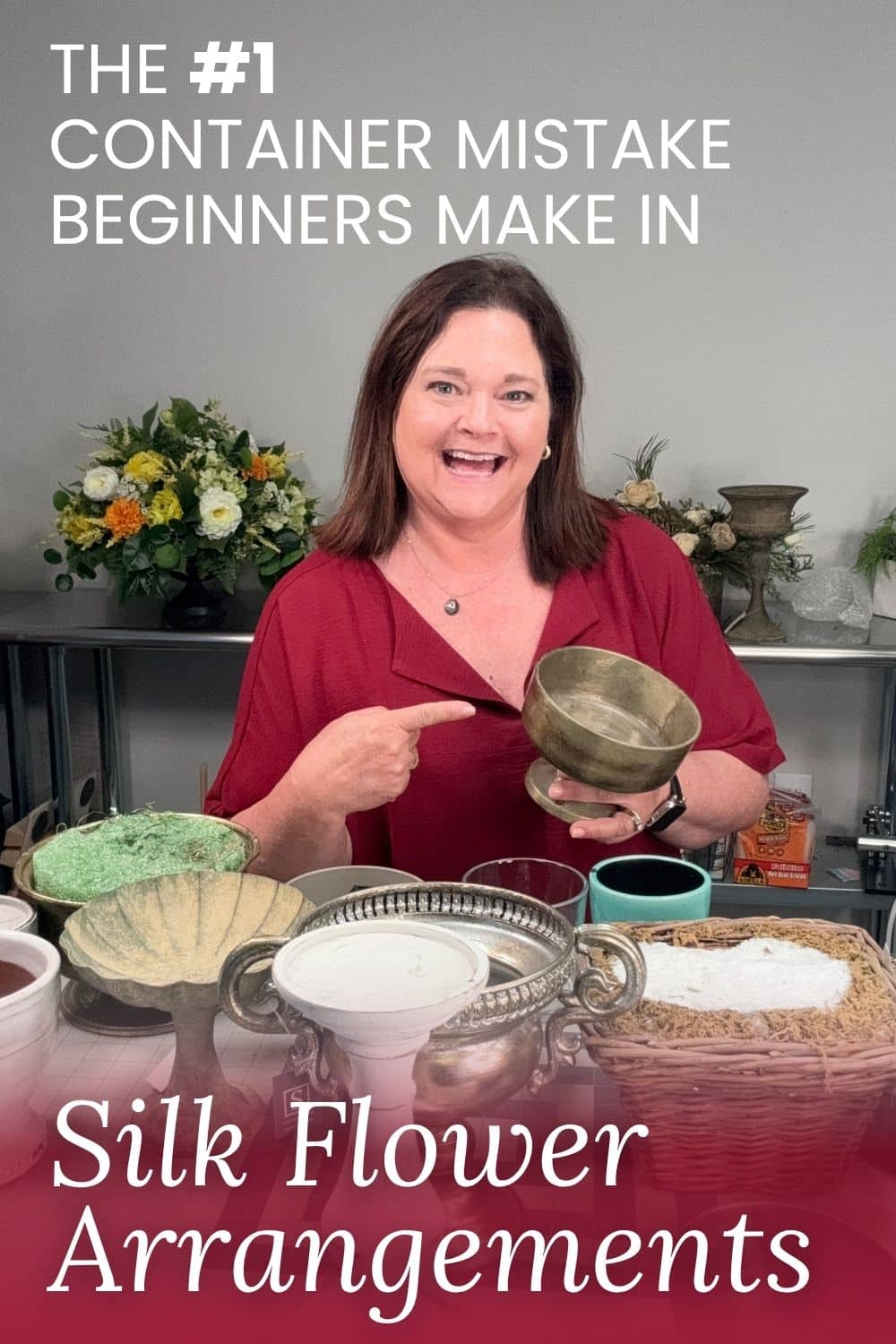
The problem is the opening of your container. Specifically, it is too big for the number of flowers you bought. Julie Siomacco of Southern Charm Wreaths has seen this trip up beginners more times than she can count, and in this post and video she is breaking down exactly why container opening size matters, the math behind it (don’t worry, it is simple!), and how many flowers you actually need for each size. Watch the full video below and then keep reading!
The Quick Answer
The #1 container mistake beginners make is choosing a container with too large an opening. A 6-inch container opening has four times the surface area of a 3-inch opening, which means four times as many flowers are needed to fill it. Beginners should stick to containers with 3 to 5 inch openings until they are comfortable with the mechanics.
The Math Behind the Container Opening
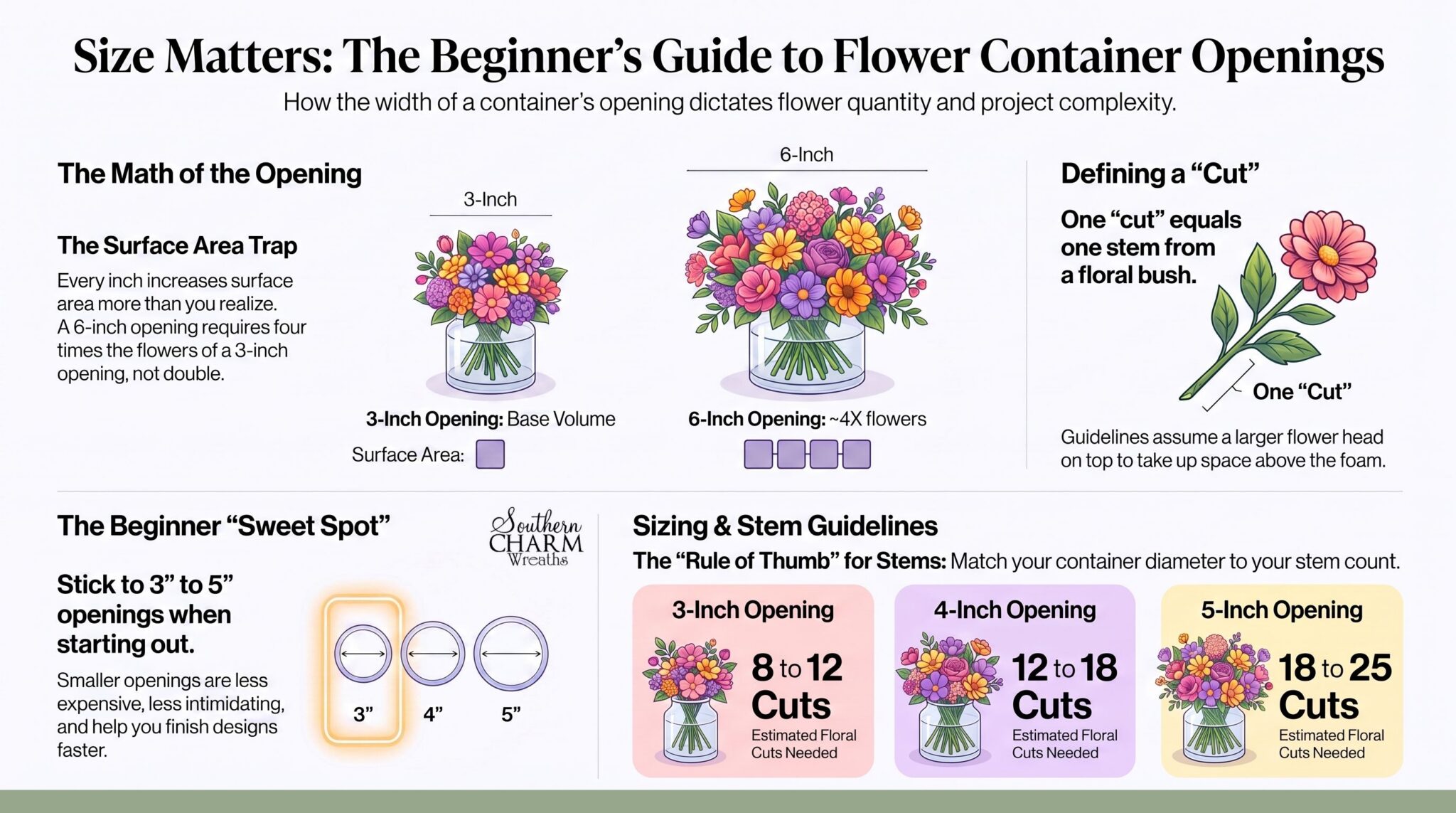
Here is where most beginners get tripped up. When you move from a 3-inch container opening to a 6-inch opening, it feels like you’re just doubling the size of your arrangement. But that is not how area works. The surface area of a circle grows with the square of the radius — which means every inch you add to the diameter multiplies the space you need to fill much faster than you’d expect.
Let’s look at what that actually means in practice:
That is not a small difference. Going from 8 cuts to 40-plus cuts is the difference between one affordable flower haul and a full shopping cart that blows your budget. No wonder beginners end up with arrangements that look sparse. They went big on the container and small on the flowers, not knowing those two things are not even close to proportional.
First, Let’s Talk About What a “Cut” Actually Is
A cut is one individual stem trimmed from a silk flower bush and inserted into the foam. A single flower bush contains multiple stems and every piece you trim off and place in the arrangement counts as one cut.
So one flower bush might give you four, five, or even eight cuts depending on how many stems it has. Keep in mind that larger flower heads take up more visual space above the foam, so they cover more area per cut than small filler stems.
This distinction matters because a lot of beginners count flower bushes rather than cuts when they are planning a project, and then wonder why they run out of material halfway through. From now on, think in cuts, not bushes!
How Many Cuts Do You Need? The General Guide
Here is a practical reference chart to help you plan your supplies before you ever set foot in the craft store. These are general guidelines — the exact number will vary based on how large your flower heads are, how full you want the finished arrangement, and how much filler greenery you’re using. But this range will keep you from running short.
| Container Opening | Cuts Needed | Skill Level |
|---|---|---|
| 3 inches | 8 to 12 cuts | Beginner |
| 4 inches | 12 to 18 cuts | Beginner |
| 5 inches | 18 to 25 cuts | Intermediate |
| 6 inches | 30 to 40+ cuts | Advanced |
| 8+ inches | 50+ cuts | Advanced |
Print this out and tape it inside your craft supply cabinet. Seriously. It will save you so many frustrating trips back to the store!
Julie’s Shopping Rule
Before Julie buys supplies for any arrangement, she measures the container opening first and writes it down. Then she uses the cuts guide to calculate how many stems she needs and she always adds 20 percent extra to that number as a buffer.
Running out of flowers mid-arrangement is one of the most frustrating experiences in crafting, and a little extra math before the shopping trip prevents it every single time.
Why Beginners Should Stick to 3 to 5 Inch Containers
There is absolutely nothing wrong with starting small! In fact, the most successful arrangement makers Julie knows all started with small containers and worked their way up intentionally. Here is exactly why that approach works so well:
Cost-Effective
Fewer cuts needed means fewer flowers to buy. You can create a gorgeous, full arrangement for a fraction of the cost of a larger container design.
Easier Mechanics
The structural mechanics of a small arrangement are simpler to manage. Less surface area means fewer decisions about placement, balance, and depth all at once.
Faster Results
You will finish a 3 to 4 inch container design much faster than a large one. Faster finishes mean more practice reps and more confidence in less time.
Confidence Building
Mastering smaller containers first makes moving to larger designs predictable rather than overwhelming. You know what full looks like, and you know how to get there.
Julie’s DIY Summer Silk Flower Arrangement for Beginners uses a small wooden box container and is a perfect first project for applying exactly this principle. And for a beautiful example of what a 5-inch container looks like when it is done right, check out the Summer Silk Flower Arrangement with Peach Roses tutorial.
A Few More Things Worth Knowing
Always prep your container before you count your flowers.
A common version of this mistake is starting to place stems before the foam is fully prepped and covered with moss. When foam is visible, you need more stems to cover it — and beginners often buy stems based on the visible container opening without accounting for the foam coverage they’ll need at the base. Julie’s foam and moss tutorial covers exactly how to prep so your base is solid before a single stem goes in.
Greenery cuts count too.
The cuts guide refers to total stems in the arrangement — flowers and greenery. If you’re planning 12 cuts for a 3-inch container, that might be 6 flower stems and 6 greenery stems working together. Greenery fills in the base, adds texture between the blooms, and covers mechanics — it is not an afterthought, and it counts toward your total coverage.
The container shape matters as much as the size.
A 4-inch round container and a 4-inch square container have the same opening size but very different design requirements. Square containers create strong horizontal lines at the base that can be tricky to soften without intentional foliage placement. Round containers are generally more forgiving for beginners because the arrangement naturally wants to flow outward in all directions from the center.
You’re Invited!!!
Now that you know the container secret, it’s time to put it into practice!
Join Julie Siomacco in her Round Arrangement Masterclass and learn how to build full, professional-looking round silk flower arrangements from start to finish.
FAQs
What is the most common mistake beginners make in silk flower arrangements?
Choosing a container with too large an opening. A 6-inch opening has four times the surface area of a 3-inch opening, which means four times as many flowers are needed to fill it. Beginners should start with 3 to 5 inch container openings until they are comfortable with the mechanics and supply planning.
How many flowers do you need for a silk flower arrangement?
It depends on the container opening. A 3-inch opening needs about 8 to 12 cuts. A 4-inch opening needs about 12 to 18 cuts. A 5-inch opening needs about 18 to 25 cuts. A cut is one stem trimmed from a flower bush and inserted into the foam — not one whole bush.
What is a “cut” in a silk flower arrangement?
A cut is one individual stem trimmed from a silk flower bush and inserted into the foam. One flower bush usually contains multiple stems, so one bush can give you four to eight cuts depending on how it’s branched. Larger flower heads cover more visual space above the foam, so they count for more coverage per cut than small filler stems.
What size container is best for beginner silk flower arrangements?
A 3 to 4 inch container opening is ideal for beginners. These require fewer flowers, cost less to fill, have simpler mechanics, and can be finished much faster than larger containers. Once you’ve mastered the smaller sizes, moving up to 5 inches and beyond becomes much more predictable.
Why does a bigger container need so many more flowers?
Because surface area grows with the square of the radius, not linearly with the diameter. A 6-inch opening does not need twice as many flowers as a 3-inch opening — it needs four times as many. Every inch added to the diameter multiplies the surface area that needs to be covered with stems and blooms.