
How to Use Artificial Flowers for Outdoor Pots
If your porch pots are looking bare and you’re not up for keeping live plants alive through the heat of summer, artificial flowers for outdoors are the answer. No watering. No wilting after one hot week. No replacing plants that didn’t make it.
In this tutorial, I’m showing you how to fill an outdoor planter with silk flowers that look like they were actually planted there.
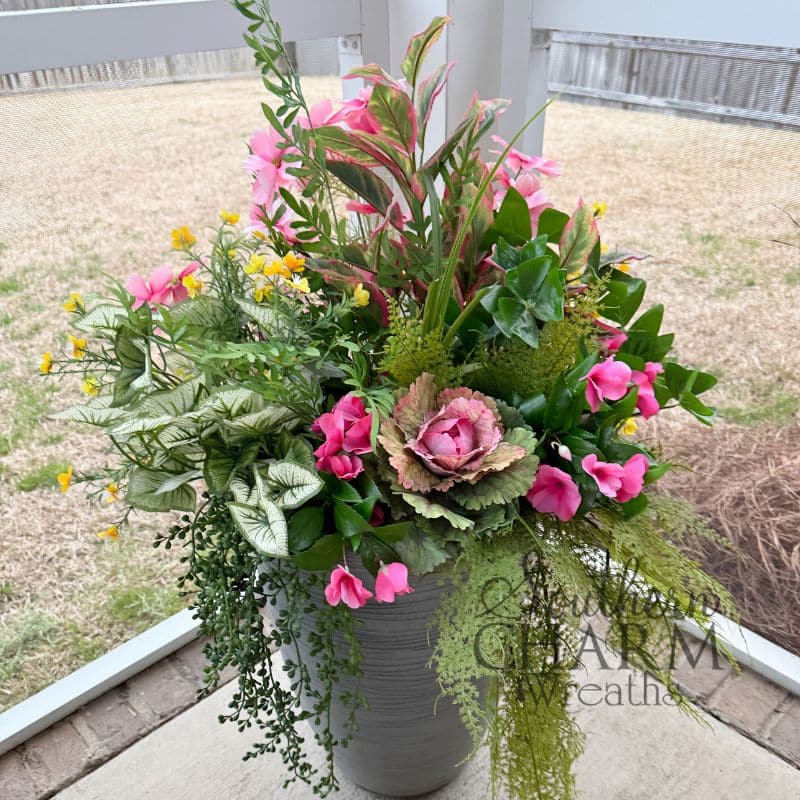
The approach Julie uses follows the classic planter design principle: thriller, filler, and spiller. The thriller is your tall, dramatic centerpiece stem that draws the eye upward. The filler is the mid-height mass of blooms and foliage that gives the pot its fullness. The spiller is the trailing greenery that cascades over the pot edges and makes the whole arrangement look naturally grown-in. When all three layers work together, the finished pot looks full and intentional rather than artificial.
How to Use Artificial Flowers for Outdoor Pots
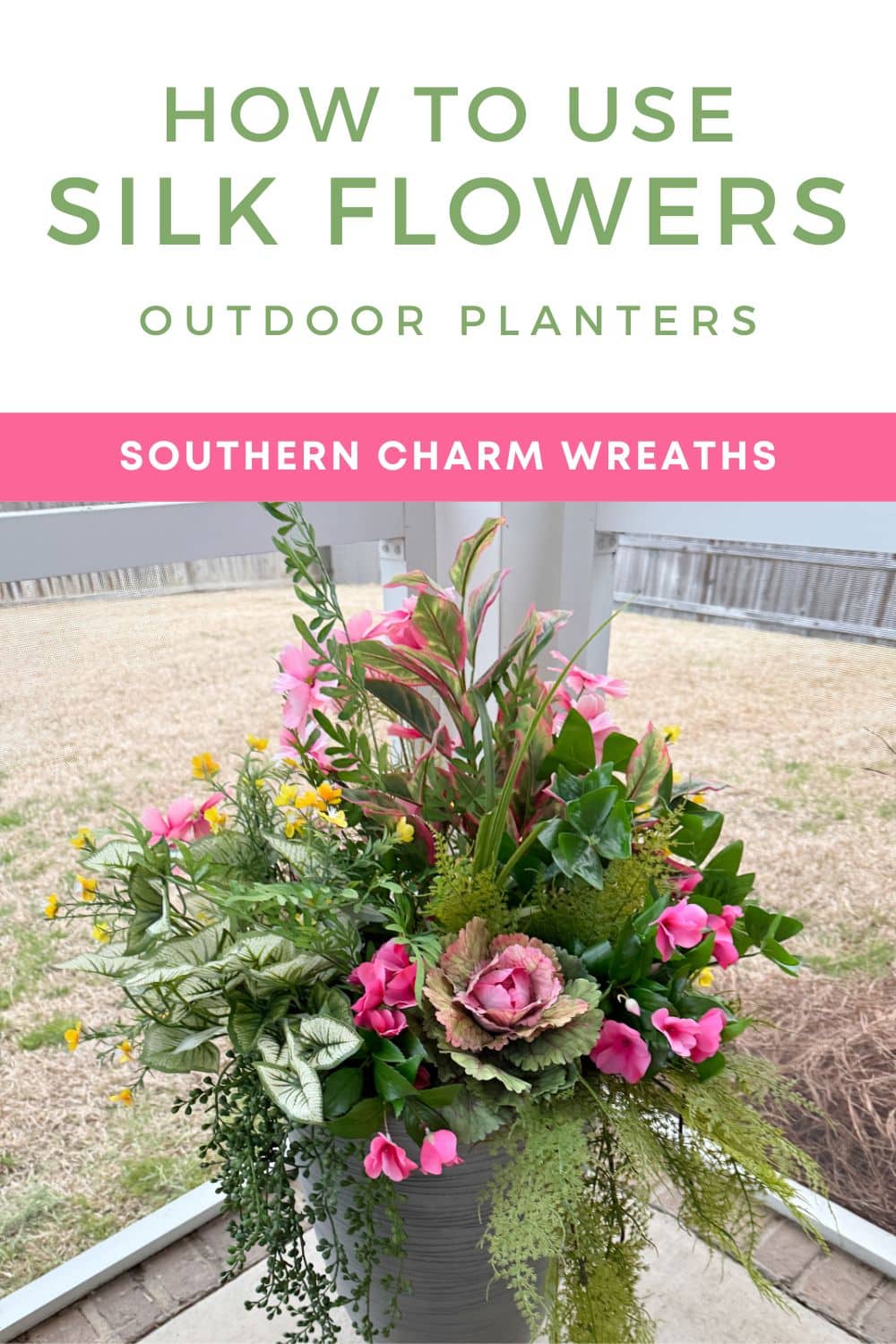
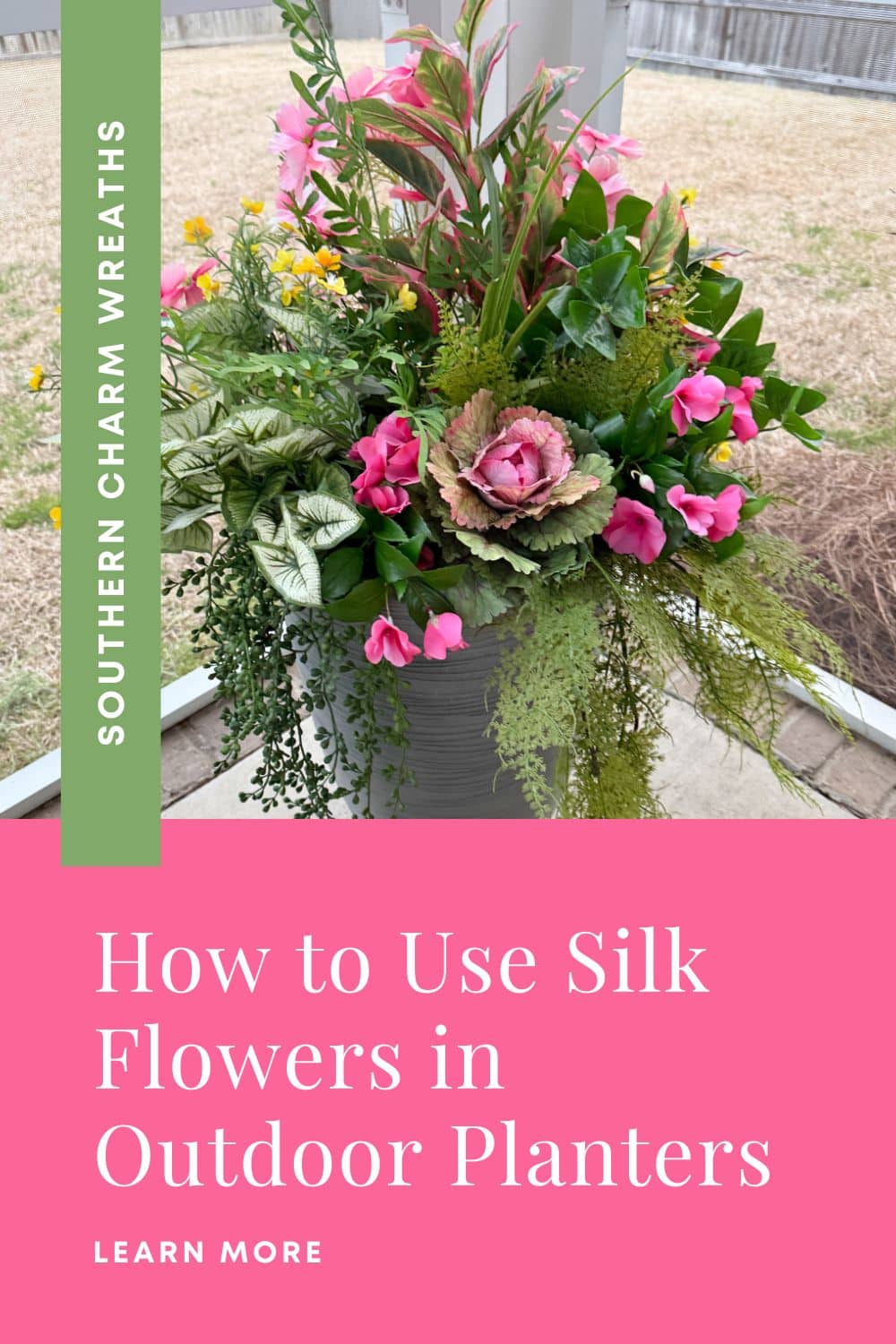
This specific design uses a pink and yellow palette with a silk ornamental kale as the centerpiece, layered with pink geraniums, sweet pea-style filler blooms, yellow accent flowers, caladium foliage, and wispy trailing greenery. Watch the full video below, then keep reading for the supply list and step-by-step instructions.
Supply List
- Outdoor planter or pot (any material — the gray ribbed pot in this design is a classic choice)
- Florist foam blocks or potting dirt to fill the base
- Spanish moss or sheet moss + floral pins to cover the foam
- Thriller: Tall upright stems silk calla lily, tropical leaf, cosmos, or agapanthus for height
- Thriller/Focal: Silk ornamental kale or cabbage as the dramatic centerpiece
- Filler: Silk pink geraniums or begonias for mid-height color
- Filler: Silk sweet peas or small pink blooms to fill the middle
- Filler: Silk yellow snapdragons, marigolds, or yellow wildflower stems for accent color
- Filler: Variegated foliage like caladium, dusty miller, or polka dot plant stems
- Filler: Mixed greenery like bay leaf, tropical leaf, or boxwood
- Spiller: Trailing stems — string of pearls, maiden hair fern, or creeping jenny
- Floral picks or wooden skewers (for adding stem length)
- Floral pins
- Hot glue gun and glue sticks
- Wire cutters
New to prepping a container with foam?
Before you start, read Julie’s tutorial on How to Foam and Moss a Container for Silk Flower Arrangements. It covers exactly how to cut, layer, and cover foam so your stems stay put and no mechanics show through the finished design.
Watch the Full Video Tutorial to Recreate the Artificial Flower Outdoor Arrangement
Step-by-Step Instructions
Prep the Planter Base
Fill your pot with potting dirt, florist foam blocks, or a combination of both. If using foam, cut blocks to fit snugly and secure with hot glue.
Pack the base to within 2 to 3 inches of the rim. Stems need enough depth to anchor without wobbling.
Cover the foam with a thin layer of Spanish moss secured with floral pins. This covers the mechanics and makes the finished arrangement look planted.
If you’re working with an existing pot of dirt, you can push stems directly in without any additional prep.
Thriller: Establish Height in the Center-Back
Your thriller stems go in first. These are the tallest, most upright pieces in the design, the ones that draw the eye upward and give the arrangement its vertical structure.
Insert them toward the back center of the pot. In this design, tall tropical leaf stems and upright pink florals create the upper structure. Aim for 12 to 18 inches above the pot rim depending on the size of your container.
Angle the stems slightly backward so they lean away from you when viewed from the front.
Thriller/Focal: Place the Statement Centerpiece
The silk ornamental kale is the second part of your thriller layer, it’s the dramatic focal point that anchors the whole design at mid-level. Place it at the center-front of the arrangement, sitting just above the rim of the pot.
The focal flower is the first thing the eye lands on, so it gets placed before anything else at that level.
Hot glue the stem base into the foam for security. If your kale doesn’t have a long stem, add a wooden floral pick to extend it before inserting.
Filler: Build Out with Mid-Height Florals
Now comes your filler layer. The blooms and foliage that make up the bulk of the arrangement.
Add your pink geraniums and filler blooms around the focal flower and extending out to both sides. Work in small clusters rather than single stems, grouping the same color together reads as more natural and intentional.
Vary the insertion depth so some blooms sit a little higher and some a little lower. This creates the layered, full look that makes a silk planter read as planted rather than arranged.
Filler: Add Variegated Foliage for Texture
Textured foliage is one of the most important parts of the filler layer.
Tuck caladium or other variegated leaf stems throughout the arrangement between the flower clusters. These foliage pieces add color contrast and visual texture that separate the blooms from each other.
Position some leaves so they angle outward over the pot rim. The leaf should partially overlap the edge, the way it would if the plant were actually growing in the pot.
Filler: Layer In Your Accent Color
Insert yellow snapdragon or wildflower stems on one or both sides of the arrangement at a slight outward angle. These are still part of your filler layer. They add color contrast within the mid-height mass of the design.
Yellow reads clearly against the pink palette even at a distance, which makes it effective as a porch accent color. Don’t concentrate all the yellow in one spot, spread it in two or three locations around the arrangement so the color is distributed rather than clumped.
Spiller: Add Trailing Stems Around the Pot Edges
The spiller is the finishing touch that separates a planter that looks designed from one that just looks stuffed.
Insert string of pearls, maiden hair fern, or creeping jenny stems at the outer edges of the pot so they drape over the side and hang down. Add them at three to four points around the pot perimeter, not just on one side.
Let them hang naturally. Don’t try to shape or control them. The casual drape is the whole point, and it’s what makes an artificial planter look genuinely planted.
Fill, Adjust, and Finish
Step back from the pot at the distance you’ll normally view it from. Look for any visible foam, bare spots, or stems that look stiff and unnatural.
Fill gaps with small greenery clippings or extra filler flowers secured with hot glue. Bend any stems that need repositioning. The finished pot should look full from every angle: front, sides, and slightly above if it will sit at ground level on a porch.
Julie’s Tips for Outdoor Planter Success
- The thriller, filler, spiller framework is the fastest way to plan a planter before you buy a single stem. Decide your thriller (tall drama), your filler (mid-height mass), and your spiller (trailing edges) before you shop and you’ll never overbuy or end up with a lopsided pot.
- Silk flowers hold up best on a covered porch or under an overhang. Direct rain and extended full sun will shorten how long the arrangement looks its best.
- UV-resistant silk florals fade more slowly than standard silk in direct sun — worth paying slightly more for if your pot gets several hours of sun a day. But you can also use a UV protection spray.
- Variegated foliage like caladium does as much work as the flowers. Don’t skip the textured leaves — they are what make the arrangement look like a planted pot rather than silk flowers in dirt.
- Trailing stems are not optional for a pot that will be viewed at eye level or from below. Without them, the pot looks top-heavy and flat.
- For wreath sellers: a coordinating porch pot sells well alongside a matching wreath. The pink and yellow palette in this design pairs directly with the Summer Wildflower Wreath for a full porch look that’s easy to photograph and list together.
Why Artificial Flowers for Outdoors Work in Pots
The most common reason people avoid artificial flowers for outdoors is the fear that they’ll look obviously fake. That concern is understandable, but it’s almost always a supply issue rather than a technique issue.
When you choose quality silk stems with realistic petal texture, layer in multiple types of greenery, and include trailing elements, a porch pot of artificial flowers is genuinely difficult to tell apart from a live one at normal viewing distance.
The practical advantages are real. Artificial planters don’t require watering, fertilizing, or replacing when a heat wave hits. You can put the arrangement together once and leave it through the full season. For anyone who loves the look of a planted porch but finds live plants hard to maintain, or who travels frequently during summer, artificial flowers for outdoors are a straightforward solution.
If you want to go deeper on silk flower arrangement techniques, the 10 Silk Flower Arrangement Tips for Beginner Floral Designers post covers the foundational design principles that apply whether you’re working in a planter, a vase, or a wreath base.
Related Tutorials on Southern Charm
These posts pair well with this one and go deeper on specific skills used in this design:
- How to Foam and Moss a Container for Silk Flower Arrangements the foundational prep step for any pot or container arrangement
- How to Use Silk Flowers in Outdoor Planters Julie’s original fall planter tutorial using dirt-filled pots
- How to Add Fake Greenery to Outdoor Pots a greenery-focused winter planter tutorial using the same container technique
- 10 Silk Flower Arrangement Tips for Beginner Floral Designers design principles for color, balance, and focal flowers
- DIY Summer Silk Flower Arrangement for Beginners a beginner-friendly container arrangement using similar florals
- Summer Wildflower Wreath pairs well with this planter for a full coordinated porch look
Frequently Asked Questions
What is the thriller, filler, spiller method for planters?
Thriller, filler, and spiller is a classic planter design framework.
The thriller is a tall, upright stem that draws the eye upward and gives the pot its height. In this design, that’s the tall tropical stems and the ornamental kale.
The filler is the mid-height mass of blooms and foliage that makes the pot look full, geraniums, sweet peas, caladium, and accent flowers all serve this role.
The spiller is the trailing element that cascades over the pot edge, string of pearls or creeping jenny in this case. Using all three layers together is what makes an artificial planter look like a professionally planted container.
Can you use artificial flowers for outdoors in pots?
Yes. Artificial flowers work well in outdoor planters, especially on covered porches, patios, and entryways. They hold their shape and color through the season without watering, fertilizing, or replanting.
For best results, keep them under a covered area out of direct rain and intense afternoon sun, and choose UV-resistant silk florals when possible.
What do you put in the bottom of an outdoor planter for artificial flowers?
You can use potting dirt, florist foam blocks, or a combination of both. Potting dirt works well if your planter already has it.
Florist foam gives more control over stem placement and holds heavier stems more securely.
If using foam, cover the top with Spanish moss or sheet moss to hide the mechanics and give the finished arrangement a natural, planted look.
How do you make artificial flowers for outdoors look real in a planter?
Choose quality UV-resistant silk florals with realistic petal texture or spray with UV protection spray.
Use multiple varieties of greenery rather than just one type. Add variegated or textured foliage between the blooms the way you’d see it in a real garden.
Let trailing stems spill over the pot edge, and vary the height of your stems so the arrangement has natural depth rather than a flat silhouette.
What silk flowers hold up best outdoors?
UV-resistant or outdoor-rated silk flowers hold up best in direct sun. Geraniums, impatiens, begonias, and ornamental kale are common choices for outdoor planter designs because they mimic the plants people typically grow in pots. If you can’t find UV-resistant, you can spray with UV Protectant spray.
For best longevity, keep the arrangement under a covered porch or overhang and out of standing water.
And color fast test them to make sure they won’t bleed when they get wet.
How do you anchor silk flower stems in an outdoor pot?
For foam-filled pots, insert stems directly into the foam and add a small amount of hot glue at the base of each stem for extra security.
For dirt-filled pots, push stems directly into the dirt. Most silk flower stems are stiff enough to anchor on their own. Heavier stems can be reinforced with wooden floral picks taped to the stem to add length and grip.